If you only looked at the Nifty and Sensex, August 2026 looked like a tired month. If you looked at gold, midcaps and the IPO board, it looked like a party. Both were true at the same time. Here is what happened, why it happened, and what it could mean for client portfolios going into the festive season.
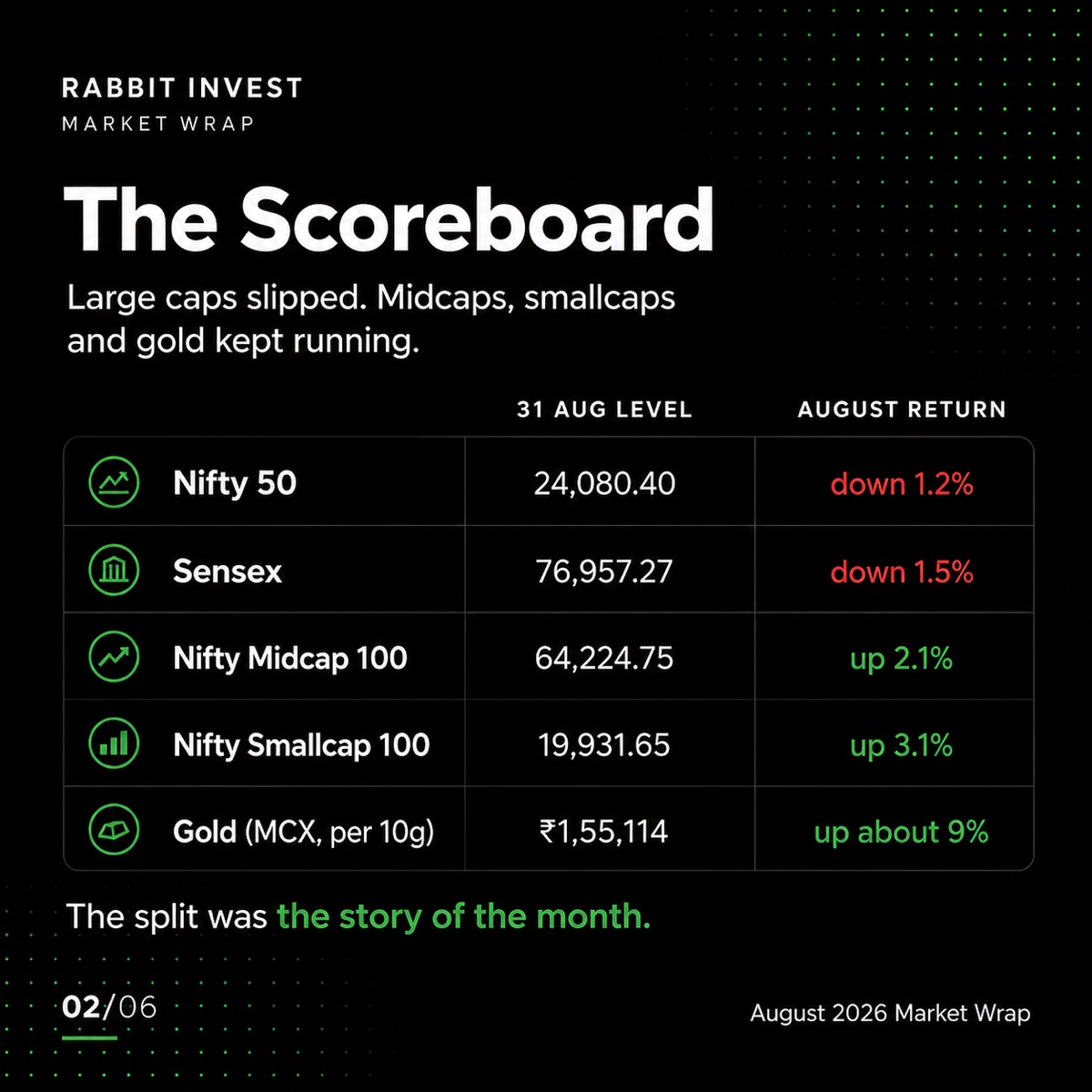
The scoreboard
| Asset | 31 Aug level | August return |
|---|---|---|
| Nifty 50 | 24,080.40 | down 1.2% |
| Sensex | 76,957.27 | down 1.5% |
| Nifty Midcap 100 | 64,224.75 | up 2.1% |
| Nifty Smallcap 100 | 19,931.65 | up 3.1% |
| Gold (MCX spot, per 10g) | ₹1,55,114 | about up 9% |
Returns are calculated from 31 July closes. The large caps snapped a two-month winning streak. Mid and small caps posted a fifth straight monthly gain. Gold had one of its best months in years. That split is the whole story.
What moved the world: West Asia and the Fed
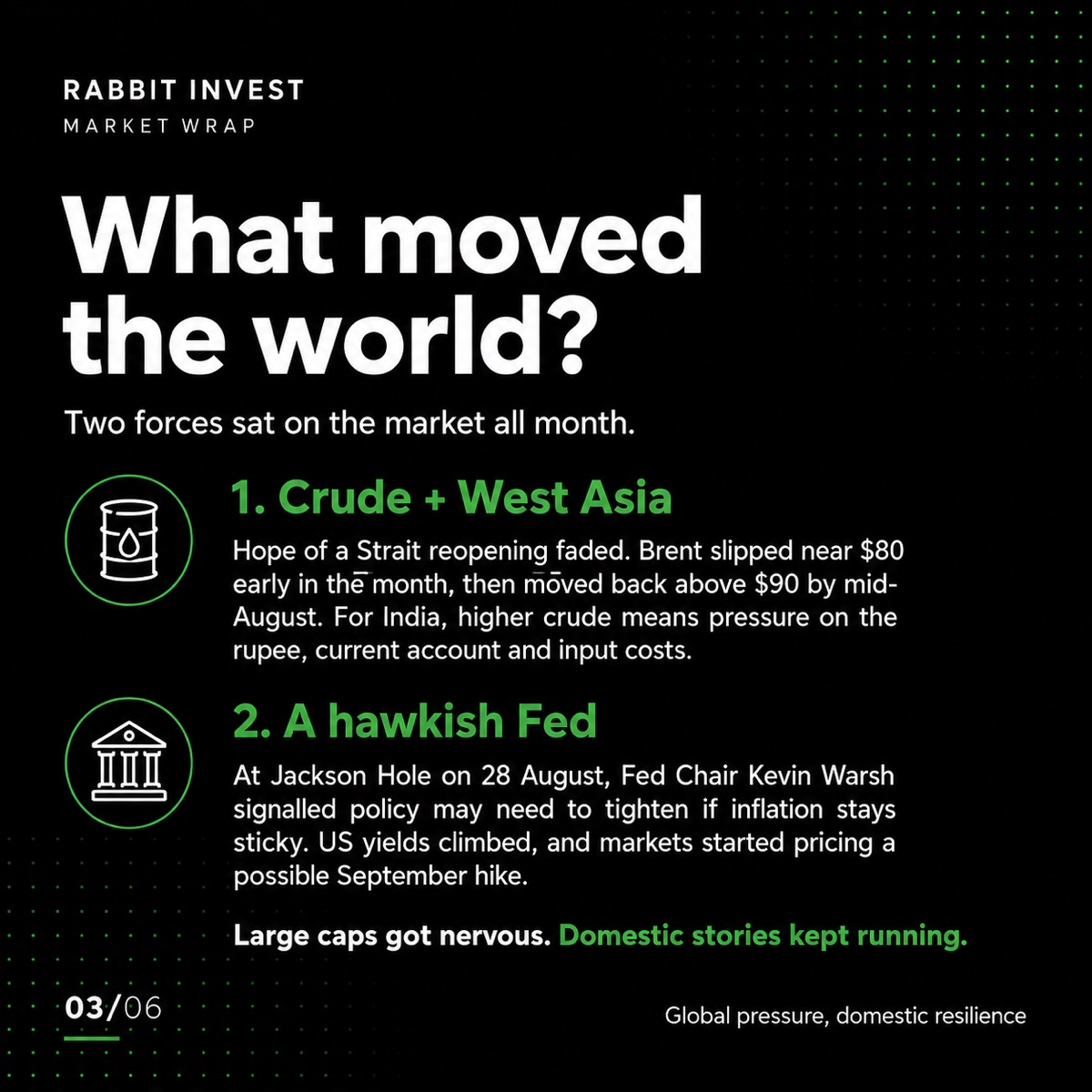
Two forces sat on the market all month.
Crude and the Strait of Hormuz. The US-Iran conflict that began on 28 February never fully settled. The month opened with hope. Around 2 August the US paused planned strikes and talks about reopening the Strait resurfaced, and Brent slid to about $80 and briefly below it in the first week. That hope faded fast. Talks stalled, Houthi attacks on Red Sea shipping widened, and by 17 August Brent was back above $90. For India, which imports most of its oil, every dollar on crude is a dollar off the current account, a bit more pressure on the rupee, and a squeeze on companies that buy oil derivatives as inputs.
The Fed turned hawkish. US inflation has stayed above target for over five years now. On 28 August, Fed Chair Kevin Warsh used his Jackson Hole speech to say policy would need to act if inflation did not come down enough. He was careful to call it a commitment to discipline, not to a decision, but markets read it clearly and strengthened expectations of a possible September rate hike. Long term US bond yields climbed through the month. Higher US yields make foreign investors think twice about emerging markets, and a stronger dollar tends to weigh on gold in the short run. On the last trading day of August, that hawkish tone knocked gold and silver ETFs off their highs.
Put those together and you get a market where the largest, most globally exposed Indian companies were nervous, while domestic stories kept running.
What moved India: the economy did its job
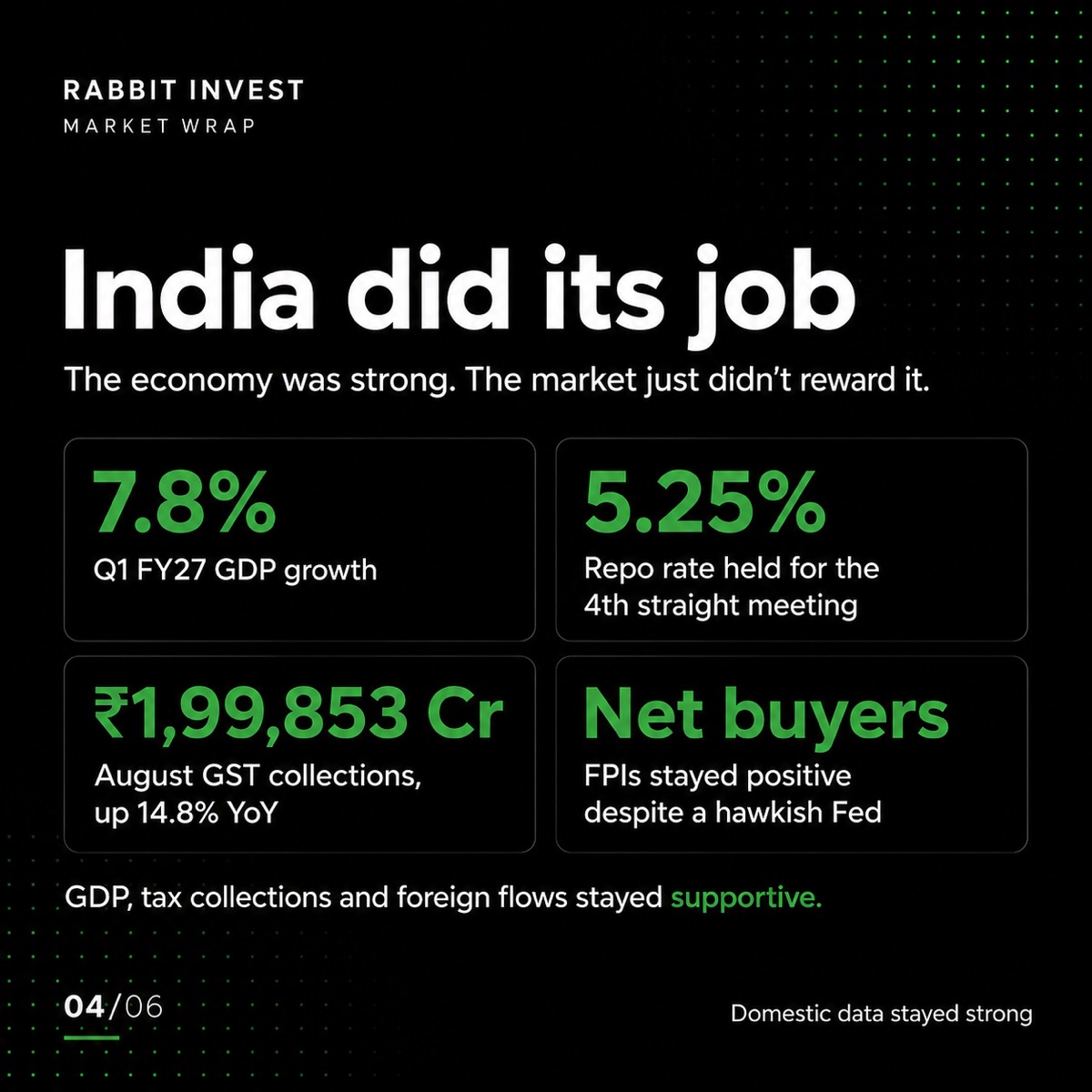
Here is the strange part. The Indian economy had a strong month. The market just did not reward it.
GDP surprised on the upside. Q1 FY27 growth (April to June) came in at 7.8%, well above the RBI's own 7% estimate and up from 6.9% a year ago. Manufacturing grew 9.2%, investment 11.9%, and services stayed strong, led by financial, real estate and professional services. Domestic demand is holding up despite a global oil shock.
RBI held, and raised its growth view. At its 3 to 5 August meeting, the MPC kept the repo rate at 5.25% for the fourth straight time with a neutral stance. It nudged the FY27 growth forecast up to 6.7% and trimmed the inflation projection to 5%. Governor Malhotra called the stance neither dovish nor hawkish. In plain terms: no cuts coming soon, but no hikes either. Next meeting is 5 to 7 October.
GST held near ₹2 lakh crore. August gross collections came in at ₹1,99,853 crore, up 14.8% year on year. Lower than July's ₹2.11 lakh crore, but the run rate is now consistently near the two lakh crore mark. The 57th GST Council meets on 12 September.
Foreign money kept coming. FPIs stayed net buyers. Estimates vary by dataset: Business Standard puts it at roughly ₹20,000 crore across primary and secondary markets, similar to July, while NSDL-based Reuters data shows $3.1 billion of equity inflows, the strongest since September 2024. Either way, foreign investors did not flee India during a hawkish Fed month. They mostly moved where they put the money.
What moved India: politics was busy, not disruptive
Parliament's Monsoon Session wrapped on 13 August after 19 working days. Eleven substantive bills got through, plus an Appropriation Bill, despite a noisy floor. The Tribunals Reforms Bill and a contentious mineral rights law that overrides a 2024 Supreme Court ruling on past dues drew the sharpest debate, mostly on federalism grounds. Our read is that none of it moved markets much. The signal for investors was continuity: the government has the numbers, the legislative machine is moving, and nothing passed that obviously changes the earnings picture for any large sector.
The bigger domestic event for markets was actually a plumbing change. SEBI's Closing Auction Session went live on 3 August for stocks underlying F&O contracts. On day one the Nifty jumped sharply in the final minutes. On 27 August, the first monthly Sensex expiry under the new regime, the indicative index swung sharply during the auction before recovering by the close. If your clients saw odd closing prints this month and asked why, this is why. It is a mechanism change, not a market signal.
Tracking the month
Sensex and Nifty. The Sensex touched its monthly high of 79,143 in the first week, riding July's momentum and the early hope of a Hormuz deal. That was the peak. The second week snapped a two-week winning streak as crude climbed back. The third week ended lower again despite a sharp Thursday rebound. The fourth week made it three losing weeks in a row, the longest such stretch in five months, as US yields rose into Jackson Hole. The final session on 31 August closed the Nifty at 24,080 and the Sensex at 76,957. The major moves broadly coincided with crude spikes and US rates scares on the way down, and with strong domestic data or diplomatic headlines on the way up.
Gold. MCX gold closed July around ₹1.42 lakh per 10g. By 5 August it was above ₹1.45 lakh as the Fed decision and US-Iran tensions pushed safe haven buying. By 7 August it crossed ₹1.49 lakh, a record at the time. The rally kept building through the middle of the month and peaked on 24 August at around ₹1.64 lakh, with Comex gold at a fresh high near $4,737 an ounce. Then Warsh spoke. Gold gave back close to ₹9,000 in the last week and closed the month at ₹1,55,114. Still up roughly 9% for August, still one of the stronger-performing major asset classes this year, but the last week was a reminder that gold is not a one way bet when the Fed gets serious about rates.
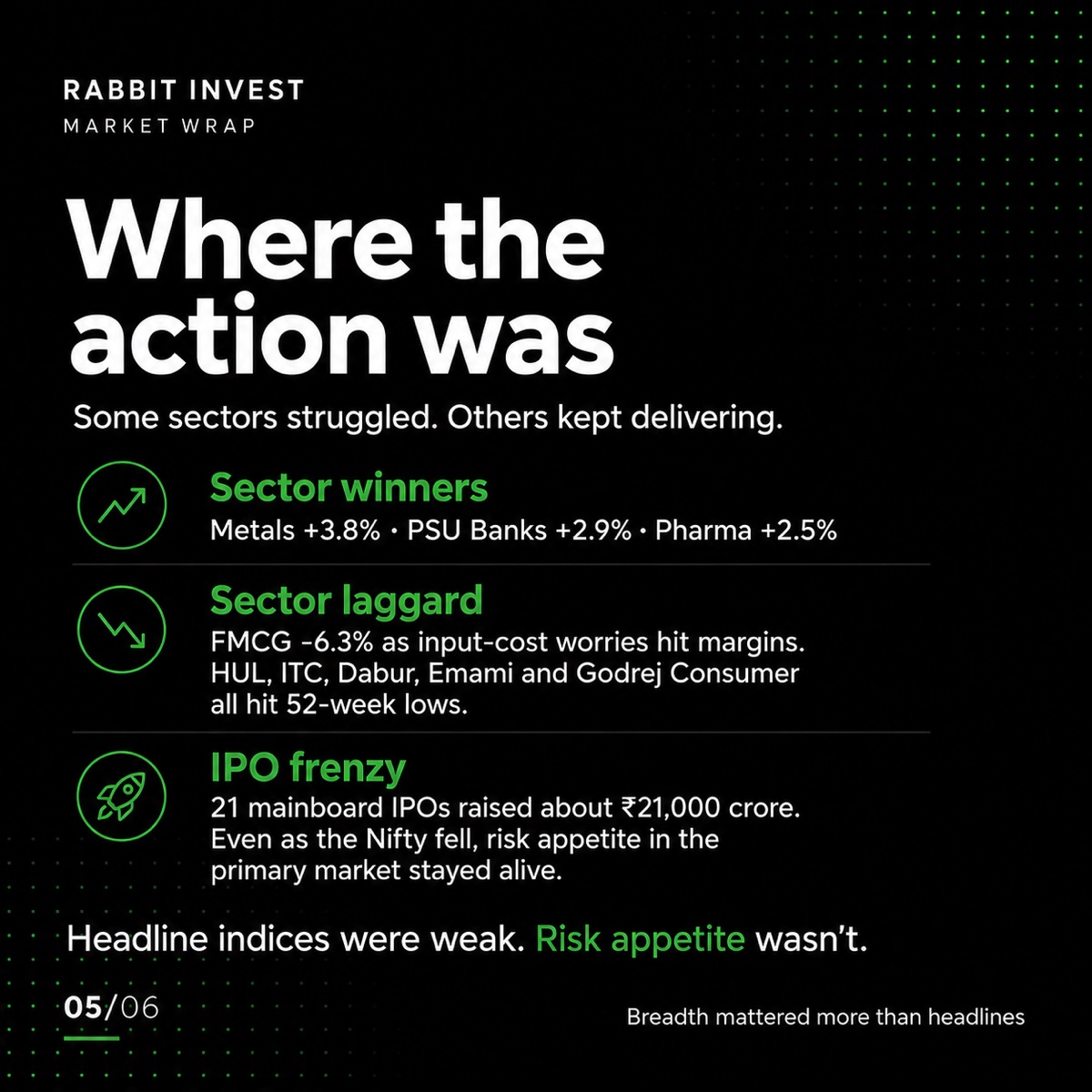
Sectors. Metals (up 3.8%), PSU banks (up 2.9%) and pharma (up 2.5%) led. FMCG was the clear laggard, down 6.3%, amid concerns that higher palm oil, crude-linked inputs and sugar costs would pressure margins. HUL, ITC, Dabur, Emami and Godrej Consumer all hit 52 week lows. Tata Motors PV, ITC, Bharti Airtel and Bajaj Finance were among the biggest Nifty losers. Grasim, Eternal and Kotak Bank among the biggest gainers.
IPOs. August was the busiest primary market month of 2026. Twenty one mainboard IPOs raised about ₹21,000 crore. Tempsens Instruments more than doubled on listing. Shiprocket rose as much as roughly 49% on debut. NSE listed market cap rose about ₹5 trillion to ₹490 trillion even as the Nifty fell. Risk appetite did not disappear: primary markets and smaller companies kept attracting capital even as the headline indices fell.
What this could mean for MFDs and their clients
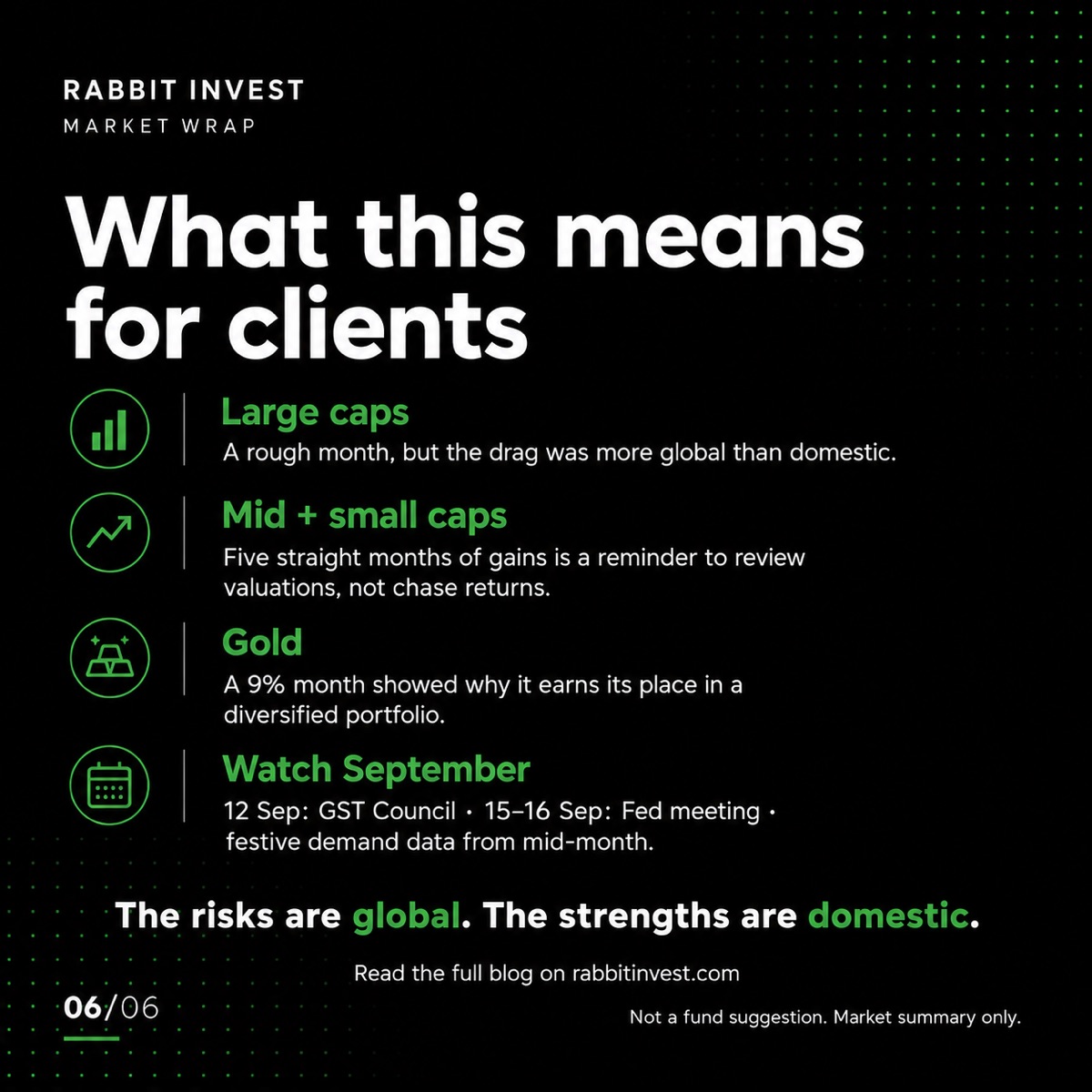
Large cap indices had a rough month. That is not a reason to panic. The drag was global (crude, US rates), not domestic. Earnings, GDP and tax collections all point the right way. Individual large cap and flexi cap funds will have diverged from the index, but at the headline-index level, the month was a modest decline rather than a major drawdown, and it came inside an economy growing at 7.8%.
Mid and small cap indices kept climbing. Five months of gains in a row. Worth reminding clients why they stayed invested through the spring volatility. Also worth a gentle word that five straight months of gains are a reason to reassess valuations rather than assume the recent pace of returns will continue. Fund-level returns will vary.
Gold earned its place. A 9% month for gold while equity slipped is the kind of diversification the asset is held for. It does not rise every time equities fall, and the last week of August showed it can drop fast when US rates turn. If a client has been asking "why do I need gold", August is a good answer. If a client is now asking "should I move everything into gold", the last week of August is also the answer.
Watch three dates in September. GST Council on 12 September. Fed meeting on 15 and 16 September. And the festive season demand data that starts trickling in from mid month. A Fed hike could pressure FPI flows and gold in the short run. A festive demand beat could lift autos and consumption names that were flat in August.
FMCG is the one sector to talk about with clients. A 6% drop in a defensive sector is unusual. The immediate concern is input costs rather than an obvious collapse in demand. Whether margins recover depends on crude, currency, pricing power and how much of the cost increase companies can pass on. Clients holding consumption or dividend yield funds will feel it either way.
The one line summary
August 2026 was a month where India's economy grew faster than expected, its government kept passing laws, foreign money kept coming, and the headline indices still fell because oil and the Fed had other plans. The broader market and gold quietly did the work. Going into September, the risks are global and the strengths are domestic.
Sources: NSE, BSE, MCX, RBI, Ministry of Finance GST release, PRS Legislative Research, Navia Monthly Wrap August 2026, Business Standard, Reuters, CNBC, EIA Short Term Energy Outlook, Federal Reserve. Index returns from 31 July closes. Figures as of 31 August 2026. This is a market summary, not a fund suggestion. Mutual fund investments are subject to market risks.